Kotahitanga in Level 1 PE

My definition of Kotahitanga is about togetherness. In a team you would see people connecting by using effective communication, uplifting and encouraging each other, making sure everyone feels involved in our group, to achieve unity. You would also see people enjoying themselves, feeling included and ultimately having fun. 

In our Level 1 PE class we have been exploring the concept of Kotahitanga through the context of Volleyball. Volleyball is a sport that really needs everyone to work together as you can’t hide behind others on the court, so it is a great sport to showcase Kotahtitanga.

Each of us have been split into four different teams that we are creating Kotahitanga in, and each team has a Coach, Manager, Captain, Stats keeper and a Referee. Each of our practical lessons are student led and we are looking at developing our skills. My role in the team is Captain and how I contribute to Kotahitanga is by teaching them skills I know, encourage and support them, lead our team cheers and take the warm up.

The strategies I used to create Kotahitanga are effective Communication, Co-operation, Manaakitanga and listening attentively.

Here you can see a video of our Kotahitanga in action from my team, the Power Puffs. 

Understanding Maori and Pasifika Health Models: A simple Comparison

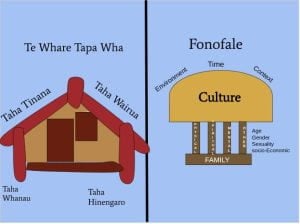
During health class we have been learning about the Te Whare Tapa Wha and the Fonofale models. Te Whare Tapa Wha was developed by leading Māori health advocate Sir Mason Durie in 1984. The model describes health and wellbeing as a wharenui/meeting house with four pou. The four pou in this model are Taha Wairua which is your spiritual well-being, Taha Tinana is your physical well-being, Taha Hinengaro is your mental and emotional well-being and then there is Taha whanau which is social well-being. But the last one is the base and that is the whenua. All these four pou are important to us Maori because when one or more of these is out of balance our well-being is impacted. 

The four key concepts of Te Whare Tapa Wha:

  • Taha Tinana(Physical well-being): 

This well-being focuses on the body’s physical health, including its capacity development, moment and growth. For Maori, the physical dimension is not isolated but interconnected with other aspects of well-being, such as mental, social, emotional and spiritual. 

  • Taha Wairua(Spiritual well-being):

Taha Wairua explores the relationship with the environment. Taha Wairua is about finding things that give your life meaning and purpose, whether through faith, connection to nature, or personal values 

  • Taha Hinengaro(Mental & Emotional well-being):

Taha Hinengaro encompasses the mind, heart, thoughts, feelings, and how you communicate and think. It’s about feeling good, coping with challenges, and thriving in life

  • Taha Whanau(Social well-being): 

Taha Whanau is all about strong connections and socializing with others. It shows the importance of strong connections with others, a sense of belonging, and identity.  

The second model we are learning about is the Fonofale model, this model is about all island ethnicity. This has been named the Fonofale from the culture of Samoan naming it “The House Of Support”. In this model there are also four pou that are similar to the T Whare Tapa Wha which are physical, mental, spiritual and other. Other stands for your age, gender, sexuality and socio-economic, the base for the fale “house” is family. 

The four key concepts of the FonoFale:

  • Physical 

Physical is all about moving your body and also looking after it, being careful of how you treat it and how you are nourishing it.

  • Spiritual

Spiritual is about finding things that give your life meaning and purpose.

  • Mental

Mental is all about recognizing the importance of your state of mind, abilities, emotions and behaviours 

  • Other 

Other include factors like gender, sexuality, age and socio-economic status. It emphasizes the interconnectedness of various aspects in life.

Thank you for reading my comparison of two of the health models, I hope these models can benefit you in the future when looking at health issues.


RAK Blog Reflection

RAK week is about giving your kindness and showing love to everybody and sharing it around regardless if it’s big or small. RAK is just a way to remember the small or even big things we do that can make a difference, for example opening a door for someone, complimenting someone or just saying something nice about them etc. If you ever do something nice to someone no matter what, you should never ask for anything in return regardless of what it is. 

Our school celebrated RAK week for the first time this year and throughout that week our 1HLT class did some things for the school and even the community. During that week some of the students went outside and drew on the ground with some chalk and also wrote some nice things for other people to see. Whaea Abby made some cookies for me and my group to give to some of the teachers with a letter that had a quote and something nice we said about them, we had some extra cookies so we gave them to some kids and some to the people that are in the AE classroom. The teachers we gave the cookies and the letters to were really happy to receive them and I was happy that they felt that way, the people in AE were also happy to receive the cookies (especially Harlem). On Thursday our health class went down next to the park to clean up the tagging that was on the sign. We also went to clean a street-light because that also had tagging on it. On our way to clean the tagging and on our way back to school we picked up any rubbish we saw laying on the ground and chucked it in the rubbish bin. The next day some of us went back down to pick up the rest of the rubbish that we missed  (there was a LOT) but while we were down there I was looking for some rubbish and I found a Nokia, so I picked it up and took it home. Overall I would say that my health class did a lot of nice things for our school and the community. 

RAK started in 1995 on the 17th of February in San Francisco, Bay area and this was founded by the Random Acts Of Kindness foundation. It was during a summer of violence when a reporter noted that people should stop reporting on “random acts of violence” and start ‘practicing random acts of kindness and senseless acts of beauty’. That started a movement. 

Te Whare Tapa Whā is a health model developed by Sir Mason Durie, highlighting four important aspects of health: physical (taha tinana), mental (taha hinengaro), spiritual (taha wairua), and family (taha whānau). RAK Week encourages acts of kindness, which enhance these dimensions. Kindness benefits both the giver and receiver, promoting compassion and connection while creating a happier community

I believe that by participating in these acts that we would create an atmosphere where kindness is encouraged and valued and to also give a good sense of acceptance for other people in our community as well as our school. Being honest I was a bit hesitant to participate in RAK week because I thought it was embarrassing to do because I thought some people would laugh and judge me because most of these people don’t know me or know me as being kind but I still participated in this event because I had to but also to try and show my kindness towards others and so I did all the RAK acts with my class.